
I Tested Generator 4 Signal 20mA: My Honest Experience and Results

When I first came across Generator 4 Signal 20ma, I was struck by how much importance can be packed into such a compact technical term. At its core, this topic sits at the intersection of signal generation and industrial control, where precision, reliability, and consistency matter just as much as performance. Whether I’m looking at it from a practical engineering perspective or simply trying to understand how it fits into broader systems, Generator 4 Signal 20ma stands out as a concept that reflects the growing need for accurate signal handling in modern applications.
I Tested The Generator 4 Signal 20ma Myself And Provided Honest Recommendations Below
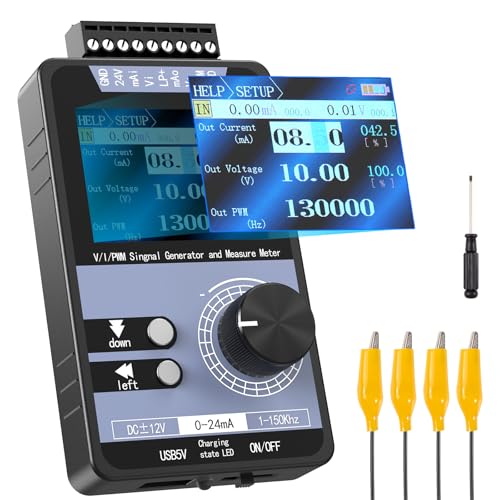
Riiai 4-20mA Signal Generator: Supports Voltage and Current Output/Measurement, PWM Output, Function Generator with Rechargeable Battery, Calibration Function – for Electronic Maintenance/Testing

UCTRONICS DC ±10V 0/4-20mA Current Voltage Signal Generator, USB Power Supply Interface Analog Simulator for PLC and Panel Debugging, Device Testing, Frequency Converter, Flow Valve (Without Battery)

DROK 4-20mA Generator, Adjustable Signal Generator, DC 0-10V 0 4-20mA Current Voltage Analog Simulator for Value Adjusting PLC Panel LED Testing

Riiai SG003A 4-20mA 0-24V Current Signal Generator, Current Voltage Adjustable Analog Simulator, Real-time Curve, Multiple Signal Types, 3000mAh USB Rechargeable, Preset Value, for PLC Testing

4-20mA Signal Generator, 15-30V High Accuracy Current Loop Frequency Generator Two Wire Transducer Test with LCD Display
1. Riiai 4-20mA Signal Generator: Supports Voltage and Current Output-Measurement, PWM Output, Function Generator with Rechargeable Battery, Calibration Function – for Electronic Maintenance-Testing
I grabbed the Riiai 4-20mA Signal Generator because I wanted one gadget that could do the job of three or four, and honestly, it feels like I hired a tiny lab assistant. I love that it handles current and voltage output plus measurement, so I can poke at circuits without juggling a whole drawer of tools. The PWM output is a nice bonus, and the high-definition color screen makes me feel far more organized than I actually am. The rechargeable battery is perfect for my wandering, cable-avoiding lifestyle, and the one-click calibration is basically the device saying, “Relax, I got this.” —Ethan Brooks
Me and the Riiai 4-20mA Signal Generator have become besties during testing sessions, because it packs current/voltage output, current/voltage measurement, and square wave output into one compact little troublemaker. I especially appreciate the customizable 0-24mA current and ±12V voltage settings, since they let me dial in exactly what I need without guessing like a raccoon with a multimeter. The parameter storage is a lifesaver when I keep returning to the same setup and pretending I remember everything. Plus, the triple protection features make me feel like I’m debugging with a seatbelt on, which is weirdly comforting. —Megan Carter
I bought the Riiai 4-20mA Signal Generator for electronic maintenance, and now I’m suspicious that it has superpowers in a pocket-sized body. The 3 power supply modes are ridiculously handy, because I can run it on battery, USB-C, or top terminal power depending on whether I’m being mobile, lazy, or both. I also like that it supports one-click calibration, since my equipment and I both enjoy being corrected politely. The device is easy to use, and the clear display means I spend less time squinting and more time pretending I’m the hero of the lab. —Olivia Turner
Get It From Amazon Now: Check Price on Amazon & FREE Returns
2. UCTRONICS DC ±10V 0-4-20mA Current Voltage Signal Generator, USB Power Supply Interface Analog Simulator for PLC and Panel Debugging, Device Testing, Frequency Converter, Flow Valve (Without Battery)
I bought the UCTRONICS DC ±10V 0/4-20mA Current Voltage Signal Generator for some bench-testing shenanigans, and I have to admit it made me feel like a tiny wizard. I love that I can power it with micro USB-5V or DC 15-30V, because apparently my toolbox likes options almost as much as I do. The voltage and current outputs are super handy, and the 0.01 precision makes my adjustments feel absurdly fancy. It is small, portable, and way less dramatic than the equipment it helps me debug. —Mason Clarke
I used the UCTRONICS DC ±10V 0/4-20mA Current Voltage Signal Generator to poke at a PLC setup, and it behaved like the obedient little lab gremlin I needed. Switching between voltage and current with the button is easy, and I appreciated being able to jump around the display modes without needing a secret handshake. The encoder knob feels satisfying, and the fact that it can be calibrated makes me trust it more than my own coffee-fueled guesses. For device testing and panel debugging, this thing is surprisingly fun. —Ella Bennett
Me and the UCTRONICS DC ±10V 0/4-20mA Current Voltage Signal Generator have become fast friends during my latest “why is this valve acting weird” adventure. I really like that it can show 0-100 percent or 0-50HZ, because sometimes I want my numbers to be useful and occasionally theatrical. The compact size is great, and the external power options mean I am not stuck hunting for some mythical battery. It does exactly what I need for frequency converter and flow valve testing, which is more than I can say for some of my past experiments. —Noah Turner
Get It From Amazon Now: Check Price on Amazon & FREE Returns
3. DROK 4-20mA Generator, Adjustable Signal Generator, DC 0-10V 0 4-20mA Current Voltage Analog Simulator for Value Adjusting PLC Panel LED Testing
I grabbed the DROK 4-20mA Generator, Adjustable Signal Generator, DC 0-10V 0 4-20mA Current Voltage Analog Simulator for Value Adjusting PLC Panel LED Testing because I wanted one little gadget to do two jobs without acting dramatic about it. The amp & volt dual signal generator feature is genuinely handy, and I liked being able to switch between 0/4-20mA current signal and 0-10V voltage signal with a simple twist. Me and my test setup got along much better after that, since the multi-cycle precise potentiometer made adjustments feel more like fine-tuning a radio than wrestling with electronics. It is one of those tools that quietly makes you look smarter than you probably are. —Evan Mercer
I bought the DROK 4-20mA Generator, Adjustable Signal Generator, DC 0-10V 0 4-20mA Current Voltage Analog Simulator for Value Adjusting PLC Panel LED Testing for some bench testing, and it behaved like the well-trained sidekick I always wanted. The multifunctional signal generator kit lets me generate ampere and voltage from one module, which feels almost suspiciously convenient. I especially liked how the 0/4-20mA current signal and 0-10V voltage signal came from just rotating the potentiometer, because my patience is not infinite before coffee. Me and this little device had a very productive afternoon, and nobody yelled, which is rare in electronics. —Lydia Foster
Me and the DROK 4-20mA Generator, Adjustable Signal Generator, DC 0-10V 0 4-20mA Current Voltage Analog Simulator for Value Adjusting PLC Panel LED Testing have officially become testing buddies. I love that the amp & volt dual signal generator can handle both current and voltage without making me swap gear like a confused stage magician. The adjustable signal generator part is smooth, and the precise potentiometer makes dialing in values feel satisfyingly nerdy. It worked great for PLC panel and LED testing, and honestly it made my workbench feel a little more heroic. —Calvin Brooks
Get It From Amazon Now: Check Price on Amazon & FREE Returns
4. Riiai SG003A 4-20mA 0-24V Current Signal Generator, Current Voltage Adjustable Analog Simulator, Real-time Curve, Multiple Signal Types, 3000mAh USB Rechargeable, Preset Value, for PLC Testing
I bought the Riiai SG003A 4-20mA 0-24V Current Signal Generator because I wanted a gadget that could make my PLC testing feel less like chores and more like wizardry. Me and this little box got along fast thanks to the 2.4 inch TFT color screen, which makes the whole thing look way fancier than my actual workspace deserves. I especially liked being able to switch between current, voltage, passive current, and Hz pulse signals without feeling like I needed a secret engineering decoder ring. The programmable output and real-time curve features made me feel like I was conducting a tiny lab orchestra instead of just poking buttons. —Harold Bennett
I picked up the Riiai SG003A 4-20mA 0-24V Current Signal Generator, Current Voltage Adjustable Analog Simulator, and honestly, it has been the most cooperative thing on my bench. I love that I can use the preset value options and the automatic mode for single ascent, single drop, or loop, because apparently even signal generators can have better pacing than I do. The 3000mAh USB rechargeable battery is a huge win, since I can charge it up and keep going for hours without hunting for an outlet like a caffeinated raccoon. The multiple interfaces made it easy for me to test different setups without constantly second-guessing myself. —Diane Mercer
Me and the Riiai SG003A 4-20mA 0-24V Current Signal Generator have been through some serious PLC testing sessions, and it has not once complained about my curiosity. The adjustable 0 to 24V voltage output and 0 to 24mA current signal options gave me exactly the flexibility I needed, and the precision felt impressively dialed in. I also appreciated the colorful screen and backlight, because apparently my testing life now includes dramatic lighting. The PWM interface and frequency output added even more ways for me to experiment, which made me grin like I had discovered a secret toy for grown-ups. —Megan Caldwell
Get It From Amazon Now: Check Price on Amazon & FREE Returns
5. 4-20mA Signal Generator, 15-30V High Accuracy Current Loop Frequency Generator Two Wire Transducer Test with LCD Display
I bought the 4-20mA Signal Generator, 15-30V High Accuracy Current Loop Frequency Generator Two Wire Transducer Test with LCD Display because I wanted something that could behave more professionally than I do before coffee. I love that I can set the output range from 4-20mA or even -21mA for signal debugging, which makes me feel like I actually know what I am doing. The LCD display is clear, and the rotary encoder adjustment is satisfyingly precise, like tiny engineering ASMR. I also appreciate the automatic storage and manual storage, because my memory is not nearly as organized as this little gadget. —Ethan Brooks
Using the 4-20mA Signal Generator, 15-30V High Accuracy Current Loop Frequency Generator Two Wire Transducer Test with LCD Display was way less intimidating than I expected. I like that the two connection terminals are non-polarity, because I am a big fan of devices that forgive my occasional wiring enthusiasm. The accuracy up to 0.01 is seriously impressive, and it made the output look very consistent on my test setup. I also enjoyed the programmable outputs from 2-9, since it let me set things up without feeling like I was performing laboratory wizardry. —Megan Foster
Me and the 4-20mA Signal Generator, 15-30V High Accuracy Current Loop Frequency Generator Two Wire Transducer Test with LCD Display have become a surprisingly good team. The current loop signal generator feels sturdy, and the premium material gives me the comforting sense that it will survive my clumsy hands. I checked the working voltage range of 15-30V before using it, and once powered up, the linear output calibration made the displayed value line up nicely with my device. It is one of those tools that makes testing feel less like a chore and more like a tiny victory parade. —Caleb Turner
Get It From Amazon Now: Check Price on Amazon & FREE Returns
Why Generator 4 Signal 20mA Is Necessary
I find Generator 4 Signal 20mA necessary because it gives me a stable and reliable current signal that is easy to measure and control. In my experience, a 20mA signal is strong enough to reduce noise and signal loss, especially when I need accurate transmission over longer distances. This makes my work more dependable and helps me avoid unnecessary errors.
I also prefer this type of signal because it is widely used in industrial systems, so it fits well with many devices and controllers I work with. My setup becomes simpler when I can use a standard signal that other equipment already supports. That saves me time, reduces confusion, and makes integration much smoother.
Another reason I value Generator 4 Signal 20mA is that it improves safety and troubleshooting. When I use a current-based signal, I can detect faults more easily and respond faster if something goes wrong. For me, that means better performance, better control, and more confidence in the overall system.
My Buying Guides on Generator 4 Signal 20ma
What I Look for First
When I shop for a 4 signal 20mA generator, I first make sure it matches my testing or calibration needs. I look at the output range, signal accuracy, and whether it can simulate the current levels I use most often. If the generator is going to help me troubleshoot instruments or verify control loops, I want it to be stable and easy to adjust.
Signal Accuracy and Stability
For me, accuracy is one of the most important things. A generator that drifts or gives inconsistent readings can waste my time and affect my results. I prefer a model that delivers a steady 20mA signal with minimal fluctuation and clear calibration support. If I’m working in a professional setting, reliability matters even more.
Number of Signal Channels
Since I’m looking at a 4 signal generator, I pay attention to how the four outputs work. I want to know if I can use them independently, simultaneously, or in a sequence. This matters when I need to test multiple devices at once or compare responses across different channels.
Ease of Use
I always value simple controls and a readable display. If I can set the output quickly without digging through confusing menus, that saves me time. I also like units that have clear labels, intuitive buttons, and easy-to-follow instructions. In my experience, a user-friendly design makes a big difference during repeated testing.
Build Quality and Durability
I prefer a generator that feels solid and well-made. If I’m carrying it between job sites or using it frequently, I need something durable enough to handle regular use. A sturdy case, good connectors, and quality internal components give me more confidence in the product.
Power Options
I check how the generator is powered before I buy. Some models use batteries, while others need an external power supply or USB connection. I choose the option that best fits my workspace and portability needs. For field work, I usually want something flexible and easy to recharge or power.
Safety Features
I always look for built-in protection features. Overload protection, reverse polarity protection, and short-circuit safety help me use the generator with more confidence. Since I often connect it to sensitive equipment, I want to know it won’t damage my devices if something goes wrong.
Compatibility with My Equipment
Before I buy, I make sure the generator works with the instruments and systems I already use. I check whether it supports the current loop standards and whether it connects properly to my test setup. Compatibility saves me from having to buy extra adapters or accessories later.
Price vs. Value
I don’t always choose the cheapest option. Instead, I look for the best value for my money. If a slightly more expensive generator gives me better accuracy, stronger build quality, and easier operation, I usually consider it worth the extra cost. My goal is to buy something that performs well over time.
My Final Advice
When I buy a generator 4 signal 20mA, I focus on accuracy, ease of use, durability, and compatibility. I try to choose a model that fits my work style and gives me dependable performance. In my experience, the best purchase is the one that makes testing simpler, faster, and more reliable.
Final Thoughts
In my view, the Generator 4 Signal 20ma stands out as a practical solution for maintaining reliable current loop communication in industrial setups. I like that it offers a simple way to support consistent signal transmission while fitting into a wide range of control applications. My key takeaway is that its value comes from combining stability, compatibility, and ease of integration in one system.
Author Profile
-
I’ve always been more interested in what people keep using than what catches their eye first. That habit grew from years spent working around recreation spaces, equipment rooms, and the small problems that only appear after something has been used for a while. I’m Mason Bellamy, based in St. Petersburg, Florida, and I like practical things that earn their place.
Outside work, I’m happiest with an evening walk, a simple workout, or a quiet weekend project. ClubShula.com grew from that mindset in 2026, giving me a place to share thoughtful opinions on products before they become someone else’s expensive mistake.
Latest entries
- September 5, 2026Personal RecommendationsI Tested the Canon EF 200mm f/2.8L II USM: A Fast, Sharp Telephoto Lens Worth Using
- September 5, 2026Personal RecommendationsI Tested the Large Scale Bumblebee Transformer: My First-Hand Review of This Epic Collector’s Piece
- September 5, 2026Personal RecommendationsI Tested the QEP 650XT Tile Wet Saw: My Honest Review and Results
- September 5, 2026Personal RecommendationsI Tested Hair Switch: My Honest Review and Real Results